
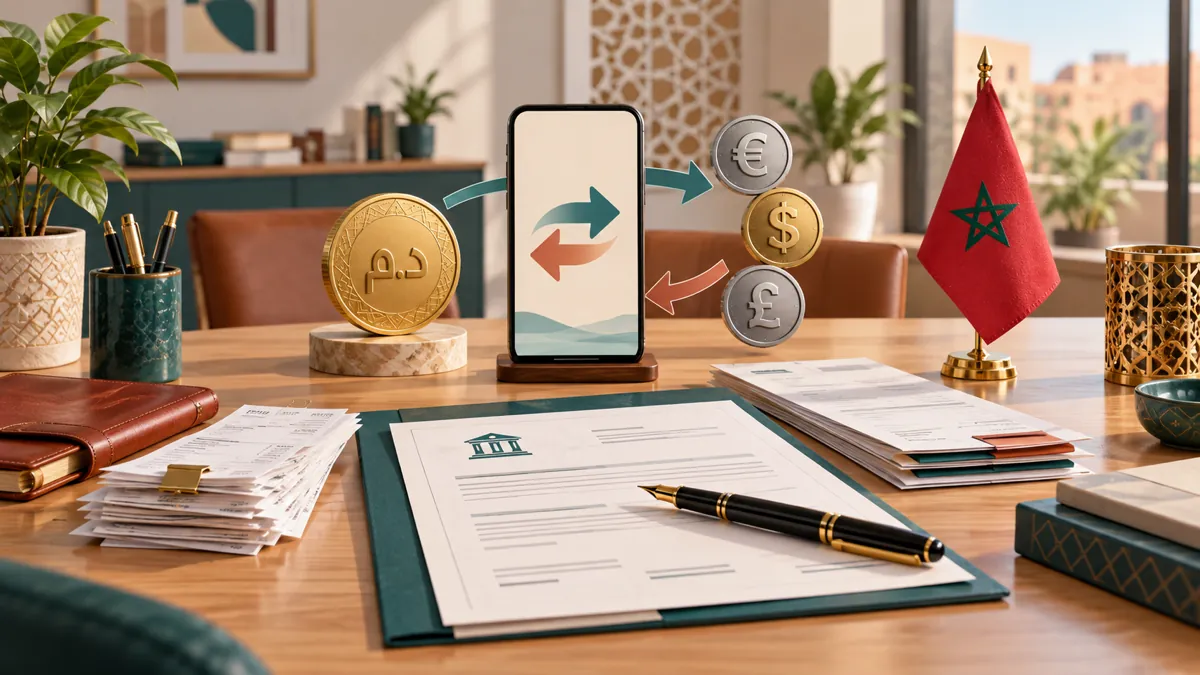
Is the Moroccan Dirham Convertible?
The Moroccan dirham is not freely convertible in the same way as an international currency such as the euro or US dollar. However, Morocco has regulated convertibility mechanisms for certain foreign funds, accounts and investments.
What happens to money later depends on where it came from, who owns it, the account used, the purpose of the operation, whether the applicable foreign-exchange rules were followed and whether the supporting documents still exist.
This is why two statements commonly heard about Morocco are both misleading: it is not correct to say that any money brought into Morocco can always leave freely, and it is not correct to say that money can never leave Morocco.
The practical rule is more useful: identify the operation, use the appropriate route from the beginning, keep the evidence and let the bank execute the transfer under the Office des Changes framework.
Last verified: October 2026. This guide uses the Office des Changes’ 2026 General Instruction for Foreign Exchange Transactions (IGOC 2026), effective from 1 January 2026. It provides general preparation information, not personalized legal, tax or financial advice.
- Is the dirham convertible?
- Convertible dirham accounts
- Account comparison
- Transferring money into Morocco
- Why proof of funds matters
- Documents to keep
- Transferring money out
- Pensions and foreign income
- Buying property from abroad
- Sale and repatriation
- Property financed with a loan
- Cash vs bank transfer
- Law vs bank policy
- FAQ
What Is a Convertible Dirham Account?
A convertible dirham account holds Moroccan dirhams, but it is designed to preserve a regulated link with eligible foreign funds. Under Article 228 of the IGOC 2026, Moroccan banks may open foreign-currency and convertible-dirham accounts for foreign individuals who are resident or non-resident, Moroccans living abroad and certain other eligible entities.
Article 228 allows these accounts to receive transfers from abroad, transfers from other foreign-currency or convertible-dirham accounts and other permitted funds. It also permits payments in Morocco or abroad, including cash withdrawals, from the available balance.
For an individual, the important point is not that a convertible account makes every future transaction automatic. It is that eligible foreign funds remain within a defined account framework that can support local spending and permitted international transfers.
This page explains that regulatory role. For account-opening steps, documents, branch choice, cards and fees, use the separate guide to opening a bank account in Morocco as a foreigner.
Foreign Currency Account vs Convertible Dirham Account
Article 228 covers both account types for eligible foreign residents, non-residents and Moroccans living abroad. The operational details offered by a bank can vary, but the basic regulatory difference is the currency held.
| Topic | Foreign currency account | Convertible dirham account |
|---|---|---|
| Currency held | An eligible foreign currency rather than ordinary Moroccan dirhams. | Moroccan dirhams connected to eligible foreign-currency inflows and other credits allowed by Article 228. |
| Typical funding | Transfers from abroad, eligible transfers from foreign-currency or convertible-dirham accounts, and permitted foreign-currency payment instruments. | The dirham equivalent of eligible foreign funds, transfers from eligible accounts and other credits allowed by the IGOC. |
| Moroccan payments | Article 228 permits payments in Morocco from the account; the bank handles the required currency conversion and execution. | Designed for spending directly in dirhams in Morocco from the available balance. |
| International transfers | Payments abroad are permitted from the available balance under Article 228, subject to the operation and bank checks. | Payments abroad are permitted from the available balance under Article 228, subject to the operation and bank checks. |
| Main practical use | Holding eligible funds in their foreign currency before conversion or use. | Using foreign-origin funds in Moroccan dirhams while keeping them within a regulated convertible-account framework. |
A standard or ordinary dirham account serves normal local banking needs. Do not assume that money held there has the same transfer treatment as funds properly held or documented under a foreign-currency or convertible-dirham framework.
What Happens When You Transfer Money Into Morocco?
A bank transfer from abroad creates more than a balance in Morocco. It also creates a record of how the funds entered the country.
Article 11 of the IGOC 2026 recognizes incoming bank transfers as a method of settlement from abroad. Article 12 lists the supporting records used for international settlements and requires banks to establish the corresponding evidence and provide a copy to the client.
The receiving account matters. Funds sent to an ordinary dirham account may be converted and used locally. Funds sent to a foreign-currency or convertible-dirham account are treated under that account’s regulatory framework. Before a large transfer, ask the Moroccan bank for the correct beneficiary details, account type, transfer wording and documents it expects.
Keep the sending-bank statement, SWIFT or transfer confirmation, Moroccan credit advice and any exchange document. If the funds finance a property or another investment, connect the transfer record to the purchase documents from the beginning.
Large transfers should be planned alongside your wider relocation budget. The cost of living in Morocco guide helps separate normal monthly spending from deposits, furniture, property and other one-time funding needs.
Why Proof of Funds Matters
Proof of funds is not one universal document. The evidence depends on the operation.
For a bank transfer, the useful trail may include the originating account statement, SWIFT confirmation, Moroccan bank credit advice and the contract or deed explaining the payment. For a pension, it may include the pension statement and bank records. For an investment, it may include the transfer evidence required by Article 12 together with the purchase, subscription, loan or notarial documents.
Cash has its own evidence rules. Under Article 228, a deposit of foreign banknotes into an eligible foreign-currency or convertible-dirham account requires either the original customs declaration for imported currency, dated no more than six months earlier, or a currency-exchange slip or other document dated no more than one month earlier showing that the banknotes were previously withdrawn from the same account.
This is a narrow rule for that specific cash deposit. It does not mean cash is illegal, and it should not be generalized into a universal declaration rule for every transaction.
Keep These Documents
The IGOC requires supporting evidence for regulated operations and specifically requires foreign investors to retain settlement evidence for investments in Morocco. Your exact file will depend on the transaction.
Keep These Documents
- SWIFT message or international transfer confirmation;
- Statements from the originating account and the Moroccan receiving account;
- Currency-exchange slips and bank debit or credit advice;
- Documents showing the original source of foreign funds;
- Pension statements when pension money is involved;
- Purchase deed and later sale deed for real estate;
- Notarial documents and payment schedules;
- Tax and payment receipts required for the transaction;
- Evidence showing how an investment or loan contribution was funded;
- Customs currency declaration when it is required for a relevant cash operation.
Do not assume your bank will be able to reconstruct the origin of funds years later.
This is a practical record-retention checklist, not an exhaustive legal list. The bank may request different evidence according to the operation and its compliance review.
Can Foreigners Transfer Money Out of Morocco?
Yes, transfers abroad are possible in many situations, but foreign nationality alone does not make every dirham balance freely transferable.
The correct analysis follows four steps:
- Rule: identify the operation covered by the IGOC, such as use of an eligible account, transferable income or sale of a qualifying foreign investment.
- Conditions: confirm the holder’s status, account, source of funds and any limits or timing rules.
- Documents: provide the evidence required for that operation.
- Bank execution: the authorized bank checks the file and executes the transfer under the exchange-control framework.
Article 228 permits payments abroad from the available balance of eligible foreign-currency and convertible-dirham accounts. Articles 171 to 177 cover transfers connected with qualifying foreign investments, including income and sale or liquidation proceeds. Other operations may follow different provisions or require Office des Changes authorization.
If you are preparing a long-term move, include these money questions in the wider moving to Morocco process rather than dealing with them after funds have already been mixed or spent.
Foreign Pensions and Foreign Income
A pension paid from abroad can be transferred into Morocco like another incoming foreign transfer, subject to the receiving account and bank checks. Keep pension statements and the full transfer trail.
Article 228 also provides a specific mechanism for a foreign resident whose pension was repatriated into an ordinary dirham account. Pension amounts from the previous 12 months may be credited to that person’s foreign-currency or convertible-dirham account on presentation of the corresponding pension statement, provided the ordinary dirham account and the receiving account are held with the same bank.
This specific mechanism should not be confused with the rules for income earned or received in Morocco. Articles 156 to 159 separately address certain work income, pensions received in Morocco and professional income of foreign individuals, with their own net-of-tax amounts, timing and supporting documents.
This page does not determine your tax residency in Morocco or personal tax liability. Those depend on facts and tax rules beyond exchange control. For retirement planning, healthcare, residency and the tax caveat, read Retiring in Morocco. For employment and remote-work context, use the guide to working in Morocco as a foreigner.
Buying Property With Money From Abroad
Real estate is included among the forms of foreign investment listed by Article 172 of the IGOC 2026. That does not make every property purchase automatically convertible.
Article 171 links the transfer guarantee to foreign investments financed in foreign currency in accordance with Article 173. The practical lesson is simple: if future repatriation may matter, document how the investment was funded from the beginning.
Use a bank transfer or another method recognized by the applicable framework, make sure the beneficiary and purpose are clear, retain the Article 12 settlement evidence and preserve the purchase deed and notarial file. Ask the bank and notary how each payment will be recorded before signing or sending a large amount.
The currency trail is only one part of the purchase. Title, permits, co-ownership, building condition, fees and resale risk belong in the separate guide on what to check before buying property in Morocco. If you have not tested daily life in the neighborhood, the guide to renting in Morocco explains why renting first can reduce risk.
Can You Repatriate Money After Selling Property or Another Investment?
General rule: under Article 171, a foreign investment financed in foreign currency in accordance with Article 173 benefits from a convertibility regime covering investment income and the proceeds of sale or liquidation.
Qualifying conditions: the investment and its financing must fit the IGOC framework. Real estate is an eligible form of investment, but the transfer treatment depends on how it was funded and documented.
Documentation: Articles 174 and 177 require the bank to examine settlement evidence and documents connected with the sale or liquidation. For real estate, the specified evidence includes copies of the purchase deed and sale deed, together with evidence concerning taxes, fees and the original foreign-currency financing.
Bank execution: the bank verifies the file and executes the permitted transfer. A purchase deed alone does not reconstruct missing transfer evidence.
If the investment does not benefit from the convertibility regime, the outcome is different. Article 174 states that the dirham proceeds, after evidence of relevant taxes and costs, are made available to a seller resident in Morocco or placed in a convertible term account for a foreign non-resident seller. Article 241 provides for funds in such an account to be transferable in four equal 25% tranches: the first when the funds are credited, then the remaining tranches annually on the anniversary date.
Property Financed Partly With a Moroccan Loan
The IGOC 2026 contains a specific route for Moroccan-dirham property loans granted to foreign non-resident individuals and Moroccans living abroad. Under Article 202, the loan may finance up to 80% of the acquisition or construction price, while the balance must be paid under the settlement rules in Article 11.
For a foreign non-resident, the loan funds are placed in a special dirham account that cannot itself be used for transfers abroad. Article 203 nevertheless allows the bank, after a later sale and on presentation of the documents required by Article 177, to transfer the net sale proceeds up to:
- the initial contribution paid in foreign currency;
- principal repayments funded through foreign-currency sales or a convertible-dirham account; and
- any capital gain realized on the sale.
This is a regulatory framework, not a promise that a bank will approve a loan or a prediction of the tax result. Eligibility, credit approval, valuation, security, costs and the sale file remain transaction-specific. Confirm the structure with the bank and notary before paying the deposit.
Cash vs Bank Transfer
Cash is not illegal by principle. The problem is that a large cash payment can create a weaker documentary chain than a transfer from an identified foreign account to an identified Moroccan beneficiary.
For money you may later want to connect to an investment or transfer abroad, banking traceability is usually more important than immediate convenience. A bank transfer can show the sender, receiver, date, amount, currency and payment reference. Cash may require a customs declaration, exchange slip or other evidence depending on the operation.
Do not invent your own workaround for a large payment. Before bringing, changing or paying significant cash, ask the bank, notary or competent authority which declaration and evidence apply to that precise transaction.
Bank Policy vs Exchange-Control Law
| Office des Changes | Bank |
|---|---|
| Defines the national exchange-control framework and the operations banks are authorized to execute. | Applies that framework to the customer’s file and transaction. |
| Sets conditions for account operations, foreign investment, transfers and supporting evidence. | Performs identity, KYC, anti-money-laundering and source-of-funds checks. |
| Determines when an operation is delegated to banks and when prior authorization may be required. | Sets internal processing steps, operational forms, review times and additional document requests. |
A bank can request more documentation before executing an operation without that request proving that the general regulation prohibits the operation. Conversely, a simple bank process never overrides the Office des Changes rules.
If a branch gives an unclear answer, ask it to identify the account type, the operation code or regulatory basis it is applying. Complex investment, inheritance or mixed-funding cases may also need a notary, accountant or qualified legal adviser.
For broader preparation around banking, property and business, the specialist guide on jobs, business, banking and property in Morocco explains why the order of these decisions matters. The Morocco residence permit guide separately covers proof of financial means for residency; that is not the same as proving the origin and regulatory treatment of investment funds.
FAQ: Moroccan Dirham and Currency Rules
Is the Moroccan dirham convertible?
The dirham is not freely convertible in the same way as the euro or US dollar. Morocco instead has regulated mechanisms for eligible foreign funds, accounts, current operations and investments. The answer for a transaction depends on the holder, source of funds, account, purpose and documents.
Can foreigners transfer money out of Morocco?
Yes, in many situations. Article 228 permits payments abroad from eligible foreign-currency and convertible-dirham accounts, and the IGOC provides routes for transferable income and qualifying foreign investments. A foreigner’s ordinary dirham balance is not automatically transferable without considering the operation and evidence.
What is a convertible dirham account?
It is a Moroccan-dirham account operating within a regulated convertible framework. Eligible foreign transfers and other credits allowed by Article 228 can fund it, and its available balance may be used for payments in Morocco or abroad under the applicable rules and bank checks.
What is the difference between a foreign currency account and a convertible dirham account?
A foreign-currency account holds an eligible foreign currency. A convertible-dirham account holds Moroccan dirhams linked to eligible foreign funds and other permitted credits. Both are covered by Article 228 for eligible foreign residents, non-residents and Moroccans living abroad.
What happens when I transfer money to Morocco?
The money is credited according to the receiving account and may be converted into dirhams. The transfer also creates evidence of how the funds entered Morocco. Keep the originating statement, transfer confirmation, Moroccan credit advice and documents explaining the purpose.
Should I keep transfer receipts in Morocco?
Yes, especially for significant transfers and investments. Article 12 requires settlement evidence, and the IGOC requires foreign investors to retain evidence of how an investment was funded. The exact documents depend on the operation.
Can I repatriate money after selling property in Morocco?
A qualifying foreign investment financed in foreign currency under the IGOC can benefit from a convertibility regime covering sale proceeds, subject to conditions and documents. If the investment does not qualify, another mechanism, including a convertible term account for a foreign non-resident, may apply.
Can foreign pension income be transferred to Morocco?
Yes, pension funds can be transferred from abroad, subject to the receiving account and bank checks. Article 228 also provides a specific same-bank mechanism for certain pension amounts from the previous 12 months that were first paid into an ordinary dirham account.
Is cash treated differently from a bank transfer?
Yes. A bank transfer creates a direct account-to-account trail. Certain foreign-banknote deposits under Article 228 require a recent customs declaration or proof that the cash was previously withdrawn from the same account. The exact rule depends on the operation.
Can a Moroccan bank refuse or delay an international transfer?
A bank may pause or decline execution if the account, operation or documents do not satisfy the regulatory and compliance review. That does not necessarily mean every similar transaction is prohibited. Ask which rule or missing document applies to the specific file.
Official Sources Used
- Office des Changes – General Instruction for Foreign Exchange Transactions 2026: Articles 9-12, 18, 156-159, 170-177, 201-203, 228 and 241.
- Office des Changes – publication notice for the IGOC 2026: effective date of 1 January 2026.
- Office des Changes – Article 228 account rules: eligible holders and account operations.
- Office des Changes – Articles 170-173 on foreign investment: definition, transfer guarantee, investment forms and financing.
- Office des Changes – Articles 174-177 on settlement and documents: sale, liquidation, property and documentary requirements.
Important: exchange-control rules and bank procedures can change. Confirm the current treatment of your exact operation with the Office des Changes, the bank executing the transfer and a qualified adviser where appropriate.