Morocco is moving.
Not in one single direction. Not always at the speed foreigners, expats or Moroccans living abroad expect. But something is clearly happening.
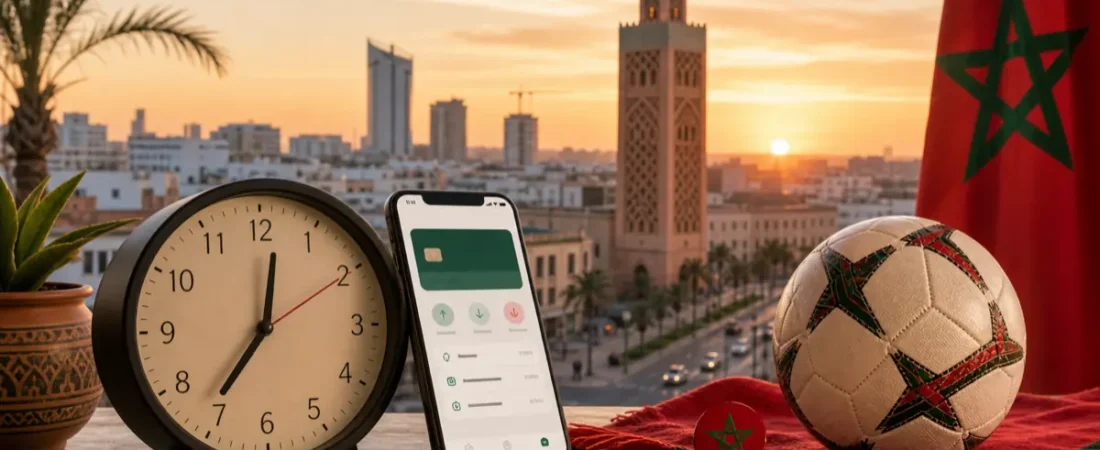
In the same week, three very different topics made people talk about Morocco: the return to GMT, the debate around Revolut entering the Moroccan market, and Morocco’s visibility through the World Cup.
At first, these topics look completely unrelated.
One is about time.
One is about banking.
One is about football.
But together, they say something much deeper about the country: Morocco is attracting more attention, changing in some areas, staying cautious in others, and moving at its own rhythm.
For anyone thinking about living in Morocco, returning to Morocco, investing in Morocco, or simply understanding the country better, these are not just headlines. They are signals.
Morocco returning to GMT: more than a clock change
The return of Morocco to GMT may sound like a technical decision.
But for people living in Morocco, time is not just a number on a phone.
It affects children going to school.
It affects parents leaving home early.
It affects work schedules.
It affects Ramadan.
It affects meetings with Europe.
It affects daily life more than many people realize.
Morocco has lived for years with GMT+1 as its standard time, except during certain Ramadan adjustments. For many Moroccans, especially families with young children, this was not just inconvenient. It often felt disconnected from the natural rhythm of the country.
When children leave for school while it is still dark, when the morning feels too early for the body, and when the official time does not match the sunlight, people feel it.
That is why the return to GMT is not only about changing the clock. It is about returning to a rhythm that may feel more natural for daily life in Morocco.
Why a stable standard time matters
One of the most overlooked points in the Morocco GMT debate is health.
The human body does not run only on official time. It responds to light, sleep, meals, prayer, work, school and daily routines.
Many sleep specialists argue that permanent standard time is generally better aligned with the body’s natural circadian rhythm than systems that keep shifting time or extend daylight saving time artificially.
In simple words: stability matters.
For Morocco, this is especially relevant because the country already has strong rhythm changes during the year, especially during Ramadan. Families, schools, businesses and workers already adapt to seasonal and religious rhythms.
Keeping a simpler, more stable time system can make daily life easier to organize.
Of course, not everyone will see it the same way. Some people liked GMT+1 because evenings felt longer. Others found it more convenient for working with Europe.
But for families, children, early workers and people who care about natural light in the morning, the return to GMT makes a lot of sense.
Morocco and France: what time difference should you expect?
This point is important for Moroccans living abroad, remote workers, entrepreneurs, freelancers and families who regularly communicate between Morocco and France.
If Morocco is on GMT, the time difference with France depends on the season.
When France is on summer time, France is two hours ahead of Morocco.
So if it is 10:00 in Morocco, it is 12:00 in France.
When France is on winter time, France is one hour ahead of Morocco.
So if it is 10:00 in Morocco, it is 11:00 in France.
This matters for business calls, online meetings, family calls, school schedules, remote work and administrative appointments.
For people living between Morocco and Europe, this is one of the most practical consequences of the change. You can also check current Morocco time details on Timeanddate before planning calls.
Revolut in Morocco: what people misunderstood
The second major topic is Revolut in Morocco.
And here, the first thing to understand is simple:
Revolut is not banned in Morocco.
That is where many people got confused.
If you live in a country where Revolut is already available, and you already have a Revolut account opened from that country, this does not suddenly stop because you travel to Morocco or spend time there.
In practice, many foreign residents, tourists, MREs and digital nomads can still use their Revolut card in Morocco where card payments are accepted, subject to Revolut’s own conditions, local acceptance, fees and account rules.
They can also use Revolut to manage currencies, exchange money and, depending on the account and country, send money to Morocco.
So the question is not: “Can Revolut still be used in Morocco?”
For existing users from supported countries, the answer is generally yes.
The real question is different.
What is actually delayed: Revolut as a local Moroccan banking actor
What has been slowed down is the idea of Revolut becoming a local financial actor in Morocco.
In other words, a Moroccan resident living in Morocco opening a local Revolut account directly from Morocco, in Moroccan dirhams, as a Moroccan-based banking service.
That is not available for now.
And this is an important distinction.
Using Revolut in Morocco with a foreign account is one thing.
Having Revolut officially operate in Morocco as a local banking or payment institution is another thing entirely.
This is where Bank Al-Maghrib, Morocco’s central bank, becomes central.
From the perspective of users, Revolut is a simple app. It feels modern, fast and convenient.
But from the perspective of a country, it touches sensitive topics: local banks, foreign currency, money flows, transfers, regulation, financial stability and control over the monetary system.
That is why Morocco is cautious.
Why Morocco is careful with fintech and foreign banking players
Many expats and MREs compare Moroccan banking with what they know in Europe.
They are used to fast apps, instant notifications, virtual cards, easy currency exchange, simple transfers and a smoother digital experience.
So when they arrive in Morocco, traditional banking can feel slower, heavier or less flexible.
This frustration is understandable.
But Morocco’s caution is also understandable.
The country has to protect its financial system, manage foreign currency flows and make sure any new player follows local regulations.
Opening the door to a major international fintech is not just a tech decision. It is a banking, regulatory and economic decision.
This is one of the clearest examples of how Morocco works.
The country wants modernization.
It wants foreign investment.
It wants to attract talent, companies, tourists and Moroccans abroad.
But on sensitive topics, especially finance, it moves carefully.
Sometimes this can feel slow.
Sometimes it can be protective.
Often, it is both at the same time.
For current sign-up availability, check Revolut’s own supported countries list.
The World Cup and Morocco’s international image
The third topic is football.
But not only football.
When Morocco performs well at the World Cup, the country receives global attention.
Millions of people see the Moroccan flag, Moroccan supporters, Moroccan emotion, Moroccan pride and Moroccan identity.
This matters.
After 2022, Morocco was no longer seen only as a tourist destination with Marrakech, beaches and the desert. The country became associated with pride, unity, energy, family, faith, discipline and a powerful diaspora.
That kind of visibility can change how people perceive a country.
It can make tourists curious.
It can make foreigners want to visit.
It can make MREs feel emotionally closer to Morocco.
It can make families want to bring their children back during holidays.
It can even make some people think more seriously about returning, investing or spending more time in the country.
Football becomes a doorway.
But it is only a doorway.
Why image is not the same as reality
This is where anyone thinking about moving to Morocco needs to be careful.
The World Cup makes people look at Morocco.
But living in Morocco requires understanding what is behind the image.
Behind the flags, there is a real society with strengths and weaknesses.
Behind the beautiful landscapes, there are rules, bureaucracy, delays, infrastructure gaps and local habits.
Behind the emotional connection, there is a daily reality that can be very different from life in Europe or North America.
This does not mean Morocco is bad.
It means Morocco has to be understood properly.
And this is where many people make mistakes.
They fall in love with the image of Morocco, but they do not prepare for the reality of Morocco.
They love the culture, the food, the weather, the family atmosphere and the sense of belonging.
But they underestimate administration, schooling choices, healthcare differences, housing issues, language barriers, banking rules, transport, work culture and the slower pace of certain decisions.
The goal is not to kill the dream.
The goal is to make the dream realistic.
What these three stories reveal about Morocco
The return to GMT shows that daily life matters.
It reminds us that Morocco is not only about big projects, tourism and investment. It is also about families, children, sleep, school, work and Ramadan.
The Revolut story shows that Morocco attracts global companies, but does not open every door immediately.
It reminds us that modernization in Morocco often comes with caution, especially when money and regulation are involved.
The World Cup shows that Morocco’s image is becoming stronger internationally.
It reminds us that the country has emotional power, cultural power and a strong global diaspora.
Together, these stories show a country that is moving, but not in a straight line.
Morocco is not frozen.
Morocco is not fully open without limits.
Morocco is not trying to become Europe.
Morocco is becoming more visible while keeping its own logic.
And that is exactly what expats, MREs and future residents need to understand.
What expats and MREs should take from this
If you are thinking about moving to Morocco, returning to Morocco, investing in Morocco or spending more time in the country, the lesson is simple:
Do not judge Morocco only through headlines.
Look at what changes.
Look at what does not change.
Look at what moves quickly.
Look at what moves slowly.
Some things in Morocco can develop fast: tourism, infrastructure, sport visibility, real estate demand, digital services and international attention.
Other things move more slowly: banking, public administration, regulation, paperwork, local services and certain daily systems.
If you understand this, Morocco becomes much easier to read.
You stop expecting everything to work like France, Belgium, the UK, Canada or the United States.
You start seeing Morocco for what it is: a country with its own pace, its own priorities, its own strengths and its own limits.
And that mindset is essential if you want to build something serious here. If you are planning your move, start with a practical guide like Moving to Morocco: The Ultimate Guide.
Living in Morocco means understanding the rhythm
Many people ask: “Is Morocco a good country to live in?”
But the better question is: “Does Morocco fit your rhythm?”
Because there is no single Morocco.
There is Morocco as a tourist.
Morocco as an MRE during summer.
Morocco as an entrepreneur.
Morocco as a parent.
Morocco as a retiree.
Morocco as a remote worker.
Morocco as someone returning after years abroad.
Each experience is different.
The same country can feel easy for one person and frustrating for another.
That is why understanding the rhythm of Morocco matters more than simply loving the idea of Morocco.
The return to GMT is about rhythm.
The Revolut debate is about rhythm.
The World Cup is about image and momentum.
And together, they show a country that is changing, but still moving on Moroccan time.
Conclusion: Morocco is moving, but you need to read it properly
Morocco is changing pace.
The country is returning to GMT.
It is attracting fintech players like Revolut, while remaining careful with banking and regulation.
It is gaining visibility through the World Cup and strengthening its image around the world.
But these stories should not be read separately.
They all point to the same reality: Morocco attracts, Morocco changes, but Morocco moves at its own rhythm.
The World Cup makes people want to look at Morocco.
But living in Morocco, investing in Morocco or returning to Morocco requires understanding what is behind the image.
That is exactly the goal of Living in Morocco: helping foreigners, expats, MREs, families, investors and future residents understand the country with honesty, clarity and practical value.
If you want to understand Morocco better, do not only follow the big announcements.
Watch the daily rhythm.
That is where the real Morocco is.
FAQ
Is Morocco really returning to GMT?
Yes. Morocco is expected to return to GMT after summer 2026, moving away from the year-round GMT+1 system that had been in place for years.
What will be the time difference between Morocco and France?
When France is on summer time, France will be two hours ahead of Morocco. When France is on winter time, France will be one hour ahead of Morocco.
Does Revolut still work in Morocco?
For people who already have a Revolut account opened in a supported country, Revolut can generally still be used in Morocco where card payments are accepted, subject to account conditions, fees and local acceptance.
Can Moroccan residents open a Revolut account from Morocco?
At the moment, Morocco is not listed as a country where residents can directly sign up for Revolut. What is delayed is Revolut becoming a local financial actor in Morocco.
Why is Morocco careful with Revolut?
Because Revolut is not just an app. It touches banking regulation, foreign currency, money transfers, local banks and financial control. These are sensitive areas for any country.
Why does the World Cup matter for Morocco?
Because football gives Morocco global visibility. A strong World Cup run can boost the country’s image, increase tourism interest and strengthen the emotional link between Morocco and its diaspora.