Morocco is presenting a confident national story: stronger growth, major infrastructure, industrial exports, tourism records and a clear ambition to become more competitive. At the same time, the images and reports from Ceuta, or Sebta as many Moroccans call it, raised a painful question: if the country is moving forward, why do some young Moroccans still feel that their future is elsewhere? The latest official Throne Day speech available on Maroc.ma, delivered on July 29, 2025, gives one side of the answer: Morocco has real achievements, but development must reach every region and every household. The Ceuta events show the other side: progress measured nationally does not always feel personal.
What King Mohammed VI Said in the Throne Day Speech
The speech most directly relevant to this debate is the latest official Throne Day text available on Maroc.ma, published by MAP on July 29, 2025. Because the brief for this article referred to a 2026 Throne Day speech, it is important to be precise: I am using the official text currently available from the Moroccan state portal, not inventing a later speech.
The message was clear. Morocco has built progress on political stability, long-term strategic choices and a more diversified economy. The King pointed to steady growth despite drought and international crises, and said industrial exports have more than doubled since 2014, especially in Morocco’s newer global sectors.
The priorities are practical: automotive manufacturing, aerospace, renewable energy, food industries, tourism, water projects and economic sovereignty. Each one matters only if it produces training, jobs, local suppliers, better services and credible opportunities beyond the main economic corridors.
The speech also insisted on something more social: infrastructure and economic development are not enough unless citizens feel the improvement in their own living conditions. It mentioned human development, social protection, support for families, regional equity and local programs that create employment, improve education and healthcare, manage water better and connect major national projects to local needs.
That is the bridge to the youth question. The official message is not simply that Morocco is progressing. It is that progress must become visible in daily life.
Morocco’s Economic Progress Is Real
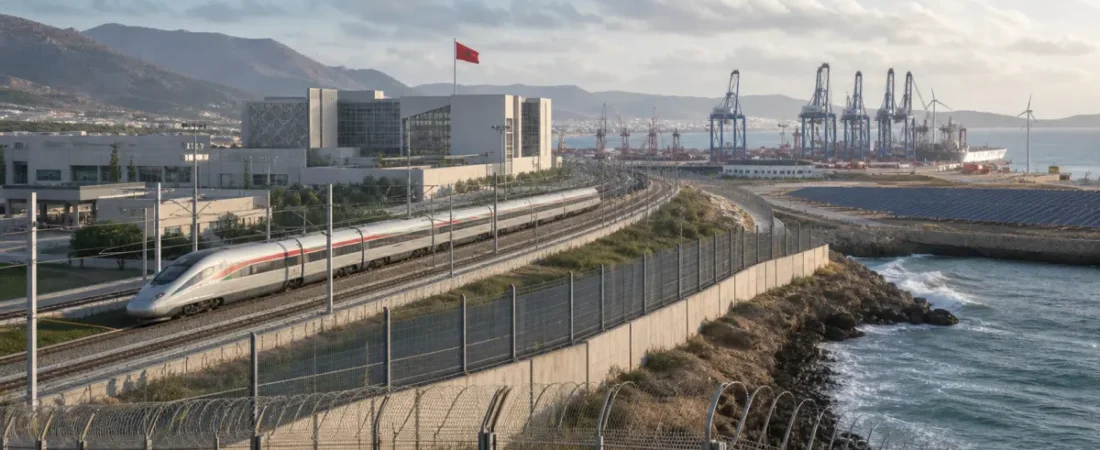
It would be dishonest to say Morocco has not changed. The country has developed modern infrastructure, expanded its port strategy, built Africa’s first high-speed rail line, attracted automotive and aerospace investment, invested in renewable energy, and strengthened its position between Africa, Europe and the Atlantic.
The macroeconomic picture is also stronger than many people realize. The World Bank’s Morocco Economic Update released in July 2026 estimated real GDP growth at 4.9 percent in 2025, described as Morocco’s strongest growth in a decade, and projected growth of 4.2 percent in 2026. It also noted low inflation at 0.8 percent and improved public finances.
Tourism has become one of the clearest symbols of this momentum. Morocco is positioning itself for major international events, improving airports, encouraging investment in hotels and services, and trying to move from seasonal tourism to a broader travel economy.
Industrialisation is another real shift. Automotive production around Tangier and Kenitra, aerospace activities around Casablanca, renewable energy projects, logistics corridors and agri-food industries show that Morocco wants to produce, export and integrate into global value chains.
But strong national indicators do not automatically translate into higher salaries, better services, stable jobs or easier housing for every person. Morocco’s progress is real, but the experience of that progress is uneven.
Why Economic Growth Does Not Feel the Same to Everyone
GDP growth can sound like a national score, but it measures production and economic activity. It does not tell you whether a young person can rent an apartment, support parents, find a stable contract, or start a business without family capital.
Purchasing power is more personal. A young worker feels rent, transport, food, mobile data, family obligations and social expectations. If wages rise slowly while ordinary life becomes more expensive, the official growth number may feel distant.
Employment quality matters too. A job can exist on paper but still be unstable, informal, low-paid, far from home or without any realistic path to promotion. In that situation, the person is not unemployed, but they may still feel trapped.
Regional development is another layer. The opportunity available in Casablanca, Rabat, Tangier or Marrakech is not the same as the opportunity available in a smaller town, rural area or disadvantaged district. Access to transport, good schools, clinics, training centers, professional networks and employers can vary greatly.
That is the gap: Morocco can progress statistically, industrially and diplomatically while some young people still ask, what does this change for me?
What Happened in Ceuta?
Ceuta is a Spanish-administered enclave on the northern Moroccan coast, commonly called Sebta by many Moroccans. Together with Melilla, it is one of Spain’s two North African territories and functions as an external border of the European Union, although Ceuta is not part of the Schengen area in the same way as mainland Spain.
In late July 2026, Ceuta became the focus of intense international attention after large numbers of people attempted to enter from Morocco, including from the area around Fnideq. According to Spanish authorities cited by the Associated Press, around 60,000 people were involved, at least 57 people died, and tens of thousands later returned to Morocco. Other AP reporting cited a range of roughly 50,000 to 60,000 people and at least 67 deaths.
Those figures should be treated carefully because early numbers in fast-moving border events can change. What can be said responsibly is that the event was large, dangerous and deeply revealing.
It showed how a local border event can become a European political issue, a Moroccan social issue and an international media story at the same time. Most importantly, it forced people to look again at why some young people may see the possibility of Europe as worth extreme risk.
Did Social Media Help Trigger the Movement?
Social media appears to have played a role, but it should not be treated as the only cause. AP fact-checking and reporting pointed to misleading messages around Spain’s rules, viral interpretations of legal decisions and claims that people who reached Ceuta would be protected. Spanish authorities also referred to criminal networks exploiting the situation.
The central confusion seems to have involved the difference between a legal ruling on removal procedures and a guaranteed right to stay. A decision that limits immediate removal in certain circumstances does not automatically give a person residence, a work permit, housing, access to mainland Spain or freedom to move across the European Union.
This difference is crucial. For a young person watching short videos on a phone, the message may sound simple: the border is open, now is the moment, everyone is going. In reality, immigration law is slower, more restrictive and much less predictable.
The precise trigger remains uncertain. What is clearer is that economic pressure, social-media amplification and misunderstanding of Europe’s legal reality can combine very quickly.
Why Do Some Young Moroccans Want to Leave?
There is no single answer. Some people leave for study, family, legal work or adventure. Others leave because they feel blocked. Some are unemployed. Others are employed but see no path to independence.
Youth unemployment and underemployment
The most recent official labor data needs context because Morocco changed methodology with the new EMO2026 labor force survey. The High Commission for Planning explains that EMO2026 replaces the older survey and is not directly comparable with past series.
In Q1 2026, the HCP reported a strict unemployment rate of 10.8 percent nationally, 13.5 percent in urban areas and 6.1 percent in rural areas. For ages 15 to 24, it reached 29.2 percent. The HCP also reported 671,000 people in time-related underemployment and broader labor underutilization of 22.5 percent nationally.
These numbers help explain why the debate cannot be reduced to “people do not want to work.” A labor market can create jobs and still leave many young people outside stable work or without enough hours and income.
Working does not always mean being able to build a future
Migration is not driven only by complete unemployment. A young Moroccan may have a job and still struggle to rent suitable housing, cover transport, support family members, save money, marry, access credit or build a small business.
The question is not only, “Do I have work?” It is, “Can this work lead somewhere?” If the answer feels like no, Europe becomes not just a place but an imagined exit from stagnation.
Of course, this does not mean every Moroccan salary is inadequate or that no opportunity exists. Many young Moroccans are building careers, companies and professional skills inside the country. But for those without strong networks, capital or a clear path, the ladder can feel too steep.
The rising cost of living
Even when inflation has cooled nationally, the memory of price increases remains. Rent, transport, food, electricity, phone costs and family responsibilities shape daily life more than macroeconomic averages.
For a young worker, the difference between income and dignity is often the ability to plan. Can I save? Can I live near work? Can I help my parents? Can I start a household? Can I make one mistake without everything collapsing?
When the answer is no, leaving becomes less about rejecting Morocco and more about searching for margin. People want room to breathe, even if the route they imagine may be much harder than expected.
A loss of confidence in social mobility
The issue is not only income today. It is confidence in tomorrow. Some young people believe effort will not necessarily lead to advancement, qualifications do not always guarantee opportunity, personal connections matter too much, or career progression is limited outside certain circles and cities.
These are perceptions, and they are not the whole story of Morocco. But perceptions matter because people make decisions based on what they believe is possible. If a young person sees no credible route from effort to improvement, the emotional appeal of migration grows.
Some Employers Say They Cannot Find or Retain Workers
There is another side to the discussion, and it should not be dismissed. Some Moroccan employers and entrepreneurs say they struggle to recruit and retain workers. They report missed interviews, lateness, absenteeism, rapid resignations, reluctance to accept certain occupations, or difficulty keeping staff even when salaries are above the legal minimum.
These experiences can be real. A small business owner who cannot find reliable staff has a real problem. A restaurant, factory, call center, farm, logistics company or service business can lose money when recruitment fails.
But this should not become a simplistic accusation against Moroccan youth. Two realities can exist at the same time: some employers genuinely struggle to recruit and retain staff, while some young people genuinely believe that the available jobs offer no viable path towards independence or long-term progress.
The reasons can include salary expectations, workplace conditions, transport costs, informal employment, lack of progression and mismatches between training and actual labor demand.
How Social Media Changes Expectations
Social media does not create every problem, but it amplifies comparison. A young person in Morocco can spend hours watching luxury cars, travel, online entrepreneurship, high incomes, European lifestyles and stories of instant success. The phone becomes a window into other people’s highlight reels.
What is hidden is just as important: debt, unstable work, failed businesses, family support, inherited advantages, years of effort, visa restrictions, taxes, high rent, loneliness and legal-status stress.
This does not mean young people are naive. Many understand that online life is selective. But constant exposure still changes expectations. A modest job that would have seemed acceptable in another generation may feel humiliating when the algorithm shows daily images of wealth and mobility.
The Europe Seen from Morocco Is Often Incomplete
Europe has real advantages. Higher wages, stronger currencies, certain public services, travel freedom and educational opportunities can make an enormous difference. Many Moroccans have improved their lives through legal migration, study or work abroad.
But the Europe visible from Morocco is often incomplete. People see the salary, the car, the suitcase, the summer return, the renovated family house and the gifts. They may not see expensive housing, inflation, long commutes, loneliness, discrimination, temporary contracts, bureaucratic stress, taxes, childcare costs or the emotional cost of family separation.
For people who arrive without legal status, the dream may be Europe, but the first reality may be informal work, unstable accommodation and fear of authorities.
How Some Moroccans Living Abroad May Reinforce This Image
Moroccans living abroad, or MREs, should be treated with respect in this debate. Many work extremely hard, support families in Morocco, send remittances, invest in property and maintain a strong emotional link with the country.
At the same time, short summer visits can unintentionally create a distorted image. A person may return to Morocco with a rental car, gifts, restaurant outings and visible spending. For two or three weeks, they may look richer and freer than they feel during the rest of the year.
Less visible are the eleven months of work, rent or mortgage payments, taxes, bills, long hours, credit and limited holidays. The summer image is real, but incomplete.
Arriving in Europe Without Legal Status Is a Different Reality
A person entering Ceuta irregularly does not normally arrive with a work contract, secure housing, legal residency, full social protection, an immediate right to work legally, guaranteed access to mainland Spain or a clear path to regularisation.
The possible reality can involve informal work, exploitation, unstable accommodation, dependency on employers or acquaintances, fear of police checks, limited ability to enforce labor rights, long procedures, detention, removal or years of uncertainty.
This is why migration pressure should be discussed honestly. It is possible to understand why someone wants to leave without romanticising the route.
Desperation can make risk look rational, but the legal and social consequences can be much heavier than the videos suggest.
Not Everyone Experiences Morocco from the Same Starting Point
One of the biggest mistakes international readers make is assuming that everyone experiences living in Morocco as an expat from the same position. They do not.
A foreign remote worker earning in euros or dollars does not face the same risk as a young Moroccan earning a local wage. A Moroccan returning from abroad with savings does not start in the same position as someone raised in a low-income household. An entrepreneur with family capital does not face the same margin of error as a first-generation graduate.
Language also matters. A foreign resident who learns Darija may understand local life more deeply, but they still may not feel the same pressure as someone whose entire future depends on the local labor market. Learning basic Darija can help expats integrate better, but integration should also include humility: not judging local frustrations only through an international income.
A personal success story may be true without representing the experience of an entire country. That sentence matters. It applies to expats who love Morocco, MREs who succeeded abroad, young entrepreneurs who made it locally, and young migrants who built a life in Europe. None of those stories is false. None of them explains everyone.
Morocco’s Main Challenge: Turning National Progress into Personal Opportunity
This is where the analysis comes back to the Throne Day speech. Morocco’s future challenge is not only to build infrastructure, attract investment, increase exports, grow tourism, host international events or expand industrial capacity. It is to make more people understand how those achievements can improve their own lives.
That means accessible employment, vocational training, career progression, better alignment between education and labor demand, affordable housing, transport, small-business financing, fair competition, regional development, quality public services and confidence in merit.
For people considering jobs, business and property in Morocco, this distinction is practical. Morocco has opportunities, but they are not distributed evenly. Some sectors are moving quickly; others remain difficult.
Morocco can progress in statistics, infrastructure and industrial capacity. But for young people to believe in the country’s future, they must be able to see how that progress can change their own future.
A country that wants to grow needs its youth to believe that working, training, creating and staying can lead somewhere.
Two Moroccos, or Two Realities Existing at the Same Time?
The simplest narratives are usually the weakest. It is too easy to say Morocco is succeeding and therefore youth frustration is exaggerated. It is also too easy to say young people want to leave and therefore Morocco’s development has failed.
The truth is more uncomfortable and more useful: several realities can exist at the same time. Morocco’s progress is real. The frustration of some young people is also real. Employers’ recruitment difficulties can be real. Low salaries and limited progression can also be real. Europe offers opportunities, but it does not guarantee security.
For foreigners and expats, Morocco is not only the country experienced through cafés, riads, beaches, property visits, road trips or online guides. It is also the country experienced by young people without the same money, mobility, passport options or second chances.
What Is Still Missing from This Debate?
The missing element is often trust. Trust that work will pay, training will lead to opportunity, regions outside the main economic corridors will not be forgotten, merit can matter, and staying can be a strategy, not only a sacrifice.
Morocco’s national ambitions are not small. The country wants stronger industry, better infrastructure, more tourism, more investment, more regional development and more sovereignty over strategic sectors. But ambition becomes socially powerful only when people see a credible place for themselves inside it.
This is why the youth question matters. It is not only about migration. It is about belonging to the future of the country.
In your view, what weighs most heavily on the decision of some young Moroccans to leave: unemployment, wages, the cost of living, social media, the image of Europe, working conditions, or a wider loss of confidence in the future? Share first-hand experiences respectfully, without insults, generalisations or anti-Morocco or anti-Europe propaganda.