You can manage many situations in Morocco with French, English, gestures and a bit of patience, but the moment conversations become fast, informal or spontaneous, it is easy to feel outside the room. That is why learning Moroccan Darija, even at beginner level, can completely change how you experience Morocco. The five simple methods in this article will help you build real listening habits.
You do not need to become fluent before you arrive in Morocco. You do not need to study grammar for hours every day. But if you want to understand Moroccans when they speak naturally, you need regular exposure to the language people actually use at home, in taxis, in markets, in cafés, in family conversations and in everyday life.
This guide is for complete beginners, members of the Moroccan diaspora who understand a little but struggle to reply, expats living in Morocco, spouses of Moroccans, regular visitors and anyone who wants to learn Moroccan Arabic in a practical way.
Why learning Darija changes your experience of Morocco
You can live in Morocco without speaking Darija. Many people do. In big cities such as Marrakech, Casablanca, Rabat, Tangier and Agadir, you can often get by with French, English, translation apps and help from people around you.
But getting by is not the same as understanding.
Darija is the language of small daily moments: a joke in a taxi, a quick comment from a shopkeeper, a family conversation at lunch, a negotiation at the market, a neighbour greeting you in the building, or someone explaining something quickly in the street.
When you understand even basic Moroccan Darija, you become less dependent. You can ask simple questions, recognise repeated expressions, understand tone, and feel more present in ordinary situations.
It also changes how people interact with you. Moroccans usually appreciate the effort, even if your pronunciation is not perfect. A few words of Darija can create warmth, humour and trust much faster than staying silent because you are afraid of mistakes.
If you want a broader introduction to the language itself, you can also read our guide: Darija: How to Learn Moroccan Arabic Before Moving to Morocco.
1. Listen to Moroccan radio to train your ear
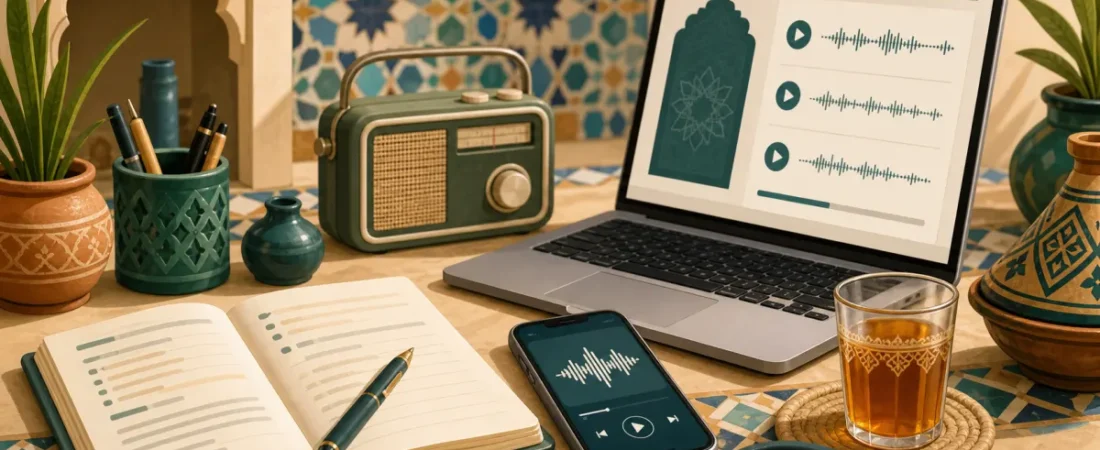
Radio is one of the simplest free ways to start learning Darija because it trains your ear without asking you to understand everything.
At the beginning, Moroccan Arabic can sound very fast. Words blend together. People shorten phrases. They switch between Darija, French, Arabic words and sometimes Amazigh or Spanish influences depending on the region.
This is normal. Your first goal is not to translate every sentence. Your first goal is to help your brain recognise the rhythm of spoken Moroccan Arabic.
A simple method is to listen for 10 to 15 minutes a day. Choose Moroccan radio, interviews, morning shows, casual discussions or phone-in programmes. Do not pause every five seconds. Let the language pass through your ear.
After a few days, start listening for repeated words. You may hear greetings, numbers, expressions of agreement, common verbs, or words linked to daily topics such as weather, prices, family, work or transport.
Write down what you recognise, even if it is only one or two expressions. The goal is not perfection. The goal is familiarity.
Radio is useful because it removes visual distractions. You are forced to listen. That can feel difficult at first, but it is exactly how you train your ear to understand Darija in real life.
2. Watch Moroccan programmes, series and Darija content
Television and video content are easier than radio because you have visual context.
If someone is cooking, arguing, shopping, laughing or asking a question, you can often guess part of the meaning from the situation. This helps beginners connect words with real-life context instead of memorising random vocabulary.
Start with short content. A 30-second clip can be more useful than a full episode if you replay it several times.
Watch once without stopping. Then watch again and listen for repeated phrases. If subtitles are available, use them, but do not become dependent on them. Subtitles can help you understand the situation, but your real goal is to hear the Darija itself.
When you hear a useful phrase, repeat it aloud. This matters. Many learners only listen passively, but speaking out loud helps your mouth get used to the sounds.
Good content for beginners includes street interviews, simple comedy clips, family scenes, cooking videos, travel vlogs in Morocco and creators who explain Moroccan expressions slowly.
You do not need to understand the whole video. If you learn one useful phrase from a clip, that is already progress.
3. Follow bilingual English-Darija or multilingual creators
Social media can waste time, but it can also become a daily Darija learning tool if you use it intentionally.
Look for creators who explain Moroccan Arabic in English, French or another language you understand. Short-form content is especially useful for beginners because it often focuses on one expression, one situation or one pronunciation point.
The key is to avoid passive scrolling.
When you see a useful expression, save it. Write it in a note. Repeat it. Try to imagine where you would use it: in a taxi, with your spouse’s family, at a café, with a neighbour, at the market, or when asking for directions.
For example, instead of learning a single word for “expensive”, learn a complete phrase you can actually use when negotiating politely. Instead of memorising a word for “where”, learn a full question you could ask in the street.
This is important because Darija is a spoken language. You need expressions that work in context, not only isolated words.
If you follow Moroccan creators who mix English and Darija, you also start noticing how Moroccans switch between languages naturally. This is part of real Moroccan communication, especially in cities and online spaces.
4. Build Darija immersion into your daily routine
The best way to learn Darija by yourself is not to wait for a perfect study session. It is to make the language appear in your daily life.
You can listen while walking, cooking, driving, cleaning or commuting. You can watch a short clip with your morning coffee. You can ask a Moroccan friend what one expression means. You can repeat greetings when you enter a shop.
If you live with Moroccan family or have Moroccan friends, ask them to explain one phrase per day. Not ten. One is enough. Then try to use it.
If you are in Morocco, small daily interactions are your classroom. The bakery, taxi, hanout, café, pharmacy, building entrance and market all give you chances to hear real Darija.
At first, you will miss most of what people say. That is normal. Do not measure your progress by how much you understand in one conversation. Measure it by whether familiar words are starting to appear more often.
Immersion works because it reduces the distance between learning and real life. You are not learning Darija as an abstract subject. You are learning it because you need it to understand Morocco.
5. Repeat useful real-life phrases
Beginners often make one mistake: they collect too many isolated words.
Vocabulary is useful, but complete phrases are more powerful.
If you learn one word for “taxi”, that helps. But if you learn how to say where you are going, ask the price, say you did not understand, or ask someone to repeat slowly, you can actually communicate.
Focus first on situations you will meet often:
- greetings and polite expressions;
- numbers and prices;
- taxis and directions;
- markets and food;
- housing and repairs;
- family visits and hospitality;
- administration and appointments;
- cafés, restaurants and shops.
Use a simple repetition system. Choose five phrases. Repeat them aloud today. Review them tomorrow. Use them again after three days. Then again the next week.
Do not only read phrases silently. Say them. Darija has sounds and rhythm that you need to feel in your mouth.
And when you make mistakes, keep going. In Morocco, trying often matters more than speaking perfectly.
How to structure your progress with Morolingo
Free content is excellent for immersion, but it can be messy. Radio, TV and social media expose you to real Moroccan Arabic, but they do not always tell you what to learn next.
That is where a structured tool can help.
Morolingo is designed to help beginners practise real-life Darija through useful vocabulary, audio dialogues, exercises and practical situations. It does not replace immersion. It gives structure to the exposure you are already building.
For example, you can use free listening methods to train your ear, then use Morolingo to review daily phrases, hear pronunciation clearly, practise common situations and repeat what you are learning step by step.
This balance matters. If you only use free content, you may feel lost. If you only use an app, you may miss the speed and variety of real Moroccan speech. Together, they work much better.
You can download Morolingo here: https://morolingo.com/download.
A simple 15-minute daily Darija routine
You do not need a complicated plan. Consistency matters more than intensity.
Here is a simple routine you can start today:
- 5 minutes of listening: Moroccan radio, a short video, a podcast clip or a simple Darija conversation.
- 5 minutes of repetition: choose two or three phrases and repeat them aloud several times.
- 5 minutes of revision: review old phrases, write them down, or practise with an app like Morolingo.
This may sound small, but 15 minutes every day is better than two hours once a month.
The secret is to make Darija normal in your life. A little every day. A phrase here, a clip there, a question to a Moroccan friend, a few minutes of audio, then repetition.
Common mistakes that slow down Darija learning
One common mistake is waiting until you understand everything before speaking. That day will never come. You become more comfortable by using small phrases before you feel ready.
Another mistake is learning only word lists. Words are useful, but phrases teach you how the language actually works in real situations.
Some beginners also translate every sentence word for word. Darija does not always map neatly onto English. Sometimes you need to learn the expression as a whole.
Practising only once a week is another problem. Darija needs repetition. Your ear needs regular contact with the language.
Finally, do not compare yourself with native speakers or members of the Moroccan diaspora who grew up hearing Darija at home. Your path is different. Your goal is progress, not perfection.
How long does it take to understand Darija?
There is no honest universal timeline.
It depends on your exposure, your consistency, your environment, your memory, your confidence and your goals.
If you listen daily, repeat useful phrases and interact with Moroccan speakers, you can start recognising common expressions relatively quickly. Holding a basic conversation takes more time. Understanding fast family conversations, jokes and regional accents takes longer.
That is normal.
Do not think of Darija as one big mountain. Think of it as layers.
First, you recognise greetings and repeated words. Then you understand simple questions. Then you start replying. Then you follow short conversations. Later, you understand tone, humour and cultural references.
Each layer changes your experience of Morocco.
Conclusion: learn Moroccan Darija through daily contact
If you want to learn Moroccan Darija for free, start with what is already around you: radio, TV, short videos, bilingual creators, daily conversations and repeated real-life phrases.
You do not need to wait until you have the perfect course, the perfect notebook or the perfect accent.
Start listening today. Choose one useful phrase. Repeat it aloud. Use it the next time you can.
Then build structure around that habit with tools like Morolingo, so your immersion becomes easier to organise and review.
The more Darija you understand, the more Morocco opens up: conversations, humour, family moments, street life, hospitality and the small details that are hard to translate.
What is your biggest challenge with Darija: understanding Moroccans when they speak quickly, remembering vocabulary or knowing how to reply?
FAQ
Can you learn Moroccan Darija for free?
Yes. You can learn a lot of Moroccan Darija for free through radio, TV, YouTube, social media, conversations and daily listening practice. A structured app or course can help organise your progress, but free immersion is a very useful starting point.
How can a complete beginner start learning Darija?
Start with greetings, numbers, prices, taxis, food, directions and everyday phrases. Listen to Moroccan content for a few minutes every day and repeat useful expressions aloud instead of only memorising isolated words.
What is the difference between Darija and Modern Standard Arabic?
Modern Standard Arabic is used in formal writing, news, official communication and education. Darija is the Moroccan Arabic spoken in daily life, at home, in the street, in shops, in taxis and in informal conversations.
Can you learn Darija by yourself?
Yes, you can make real progress by yourself if you listen consistently, repeat phrases, write down useful expressions and practise with Moroccan speakers when possible. Self-study works best when you combine free immersion with a structured method.
How can I understand Moroccans when they speak quickly?
Train your ear with short daily listening sessions. Do not try to understand every word at first. Replay the same clips, listen for repeated phrases, and gradually build familiarity with rhythm, pronunciation and common expressions.
What is the best app for learning Moroccan Darija?
Morolingo is a useful option for beginners because it focuses on real-life Darija vocabulary, audio dialogues, exercises and practical situations. You can use it alongside free listening methods to add structure to your learning.