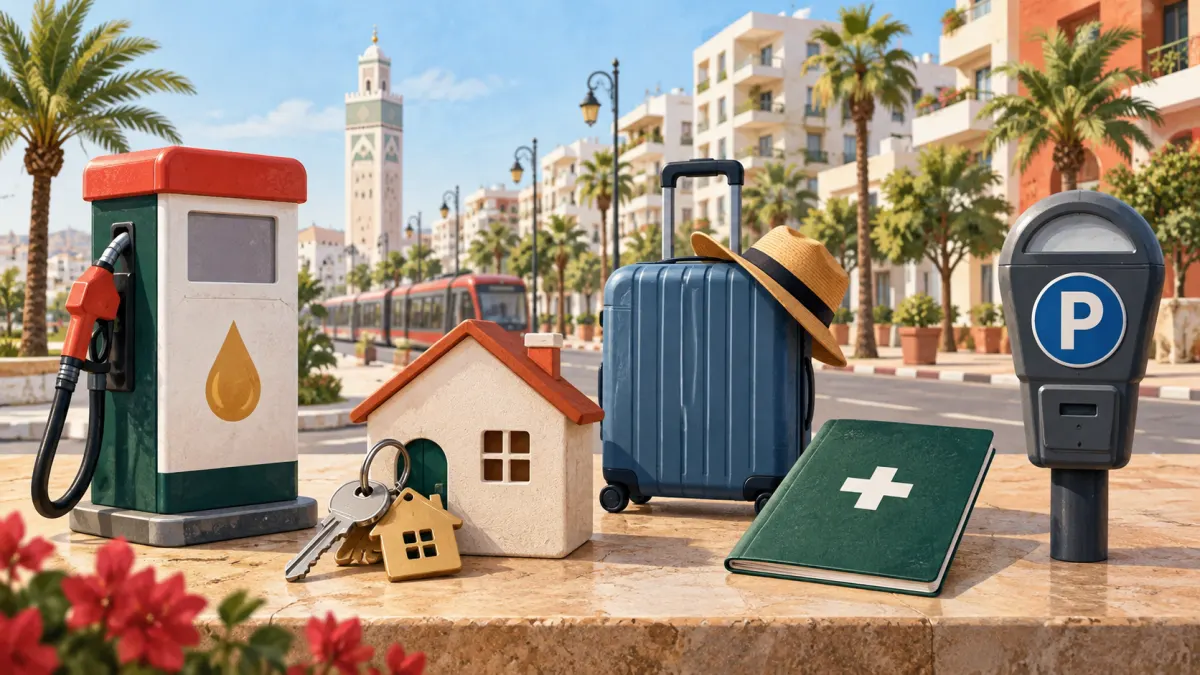
Morocco entered October 2026 with a mixed set of signals: diesel moved above 16 Moroccan dirhams (MAD) per litre at some stations, official property transactions rebounded, and tourism arrivals reached a new high. At the same time, public-health authorities were monitoring diphtheria cases, while Agadir moved closer to bringing back paid parking.
These are not five isolated headlines. They affect everyday decisions about transport, housing, family health and where to live. The details also matter: a national average is not a local price, a property index does not describe every new development, and an approved parking framework is not the same as fees already being charged.
Last verified: 11 October 2026.
At a glance: five Morocco updates to understand
- Fuel: indicative diesel prices in Casablanca rose to about MAD 16.10 per litre on 1 October, but prices vary by distributor, station, city and date.
- Property: the official Q2 index showed transactions up 11% quarter on quarter and prices up 0.7%, after a very weak first quarter.
- Tourism: Morocco recorded 15.7 million arrivals from January through September, a total that includes Moroccans residing abroad as well as foreign visitors.
- Health: authorities reported a limited number of confirmed diphtheria cases and reinforced surveillance and vaccination messaging.
- Agadir parking: the municipal council approved a framework concerning 198 parking areas covering more than 23 hectares, but rates and a start date were not yet confirmed.
1. Fuel prices: what drivers should know
On 1 October, diesel increased by about MAD 0.80 per litre, taking the indicative average in Casablanca to roughly MAD 16.10. Petrol rose by about MAD 0.39 to around MAD 15.60, according to reporting based on distributor prices at the start of the month.
Those figures are a useful reference, not one fixed national pump price. Morocco’s fuel prices can differ by distributor and location, and transport costs to more distant areas can affect what a station charges. A price observed in Casablanca on 1 October should not be presented as the price paid at every station across Morocco for the whole month.
For a driver filling a 50-litre diesel tank, an increase of MAD 0.80 adds about MAD 40 to that fill. The effect can be more noticeable for a household with two cars, a long commute or regular intercity journeys. Businesses that depend on road transport may also face higher operating costs, although it would be too simplistic to assume that every delivery or taxi fare will immediately rise by the same percentage.
The practical response is to update the transport line in your household budget and check actual local prices rather than relying on a national headline. Our 2026 cost of living guide can help you place fuel alongside rent, food, utilities and school costs.
2. Property: why the headlines seem contradictory
The official Residential Property Price Index, published by Bank Al-Maghrib and Morocco’s National Agency for Land Conservation, Cadastre and Cartography (ANCFCC), showed a quarter-on-quarter recovery in Q2 2026. Transaction numbers rose by 11%, while prices increased by 0.7%. Compared with the same quarter of 2025, transactions were up 6.3% and prices were also up 0.7%.
That sounds strong until the comparison point is considered. Q1 data had shown a 40.2% quarterly fall in transactions. The Q2 rebound therefore followed an unusually sharp decline; it does not prove that every part of the Moroccan property market is booming.
There is another important distinction. The official index is built from registered ANCFCC transactions and uses a repeat-sales method. It is especially useful for tracking price movements in properties that have changed hands more than once. It is not a complete measure of every home on the market, every asking price or every new-build project.
In October, property developers separately raised concerns about weak demand, rising construction costs and the gap between production costs and household purchasing power. Those statements mainly describe pressures in the development and new-build market. They can coexist with a rebound in registered resale transactions.
For a buyer, the national numbers should be treated as context rather than a valuation. Casablanca, Rabat, Tangier, Marrakech and Agadir contain very different submarkets, and neighborhood, title status, building management, condition and resale demand can matter more than a national quarterly percentage. Before committing, use our guide to buying property in Morocco. New arrivals will usually learn more by renting first and testing daily life in the neighborhood.
3. Tourism: where growth is showing up
Morocco welcomed 15.7 million arrivals during the first nine months of 2026, according to figures announced by the Ministry of Tourism. That was about 717,000 more arrivals than in the same period of 2025, an increase of 5%. September alone recorded more than 1.5 million arrivals, up 8% year on year.
For international readers, the definition matters. Morocco’s headline arrival total includes both foreign tourists and MREs, the common French abbreviation for Marocains résidant à l’étranger, or Moroccans residing abroad. It should not be read as 15.7 million foreign holidaymakers.
Other indicators support the broader growth picture. The Office des Changes reported travel receipts of MAD 97.9 billion from January through August, up 9.7% year on year. Official accommodation data available earlier in the year also showed overnight stays rising, with growth in major destinations including Marrakech, Agadir, Casablanca, Tangier and Rabat.
For residents, the most visible effects are local and seasonal. Busy tourism periods can mean more traffic, fuller restaurants, greater pressure on short-term accommodation and stronger demand for tourism services. They can also support shops, transport providers, guides and hospitality businesses. But national arrival figures alone do not prove that local wages, long-term rents or household incomes have risen. Those outcomes need separate evidence.
If you are choosing a city, look beyond annual visitor totals. A tourism-focused area may feel very different in August and January. Test transport, noise, services and neighborhood activity in the season when you expect to live there.
4. Diphtheria: verified information for residents and families
Diphtheria is a contagious bacterial disease that most often affects the upper respiratory tract and can produce a toxin that damages the heart and nerves. The World Health Organization describes vaccination as the most effective prevention and recommends a multi-dose primary series followed by booster doses.
Moroccan health reporting in 2026 needs to be read by date and outbreak. During a Ministry of Health webinar on 7 October, officials said the current outbreak under monitoring involved 11 laboratory-confirmed cases, including one death. Earlier in the year, authorities had investigated separate clusters and sporadic cases. Initial reports in late September focused on Agadir Ida-Outanane and Chtouka Ait Baha in the Souss-Massa region. A suspected case reported in Casablanca was later ruled out after examination, which is a useful reminder that suspected and confirmed cases are not interchangeable.
The reported numbers do not support panic, but they do support checking routine vaccination records. Morocco’s National Immunisation Programme includes diphtheria vaccination, and public primary-care facilities provide routine childhood vaccines. Families who are uncertain about a child’s schedule should take the vaccination record to a qualified doctor or public health centre and ask what is currently due. This article cannot assess an individual’s vaccination or medical needs.
Availability also requires careful wording. Reports on 5 and 6 October described a temporary constraint affecting some combined vaccines in the private market. The Moroccan Agency for Medicines and Health Products said supply for the public immunisation programme remained available, while additional lots for private distribution were going through release procedures. That did not establish that every private clinic or pharmacy had stock on a particular day. Verify locally before making a special journey.
Our healthcare guide for expats explains how public facilities, private clinics, pharmacies and health planning fit together. Seek prompt professional medical advice if you have health concerns or possible symptoms.
5. Agadir parking: what may change and what remains unconfirmed
Agadir’s municipal council approved a draft framework in its October session to organise and manage paid parking through Grand Agadir Mobilité et Déplacements Urbains, the local mobility company. Reporting on the proposal referred to 198 parking areas in three categories, together covering more than 23 hectares.
This is significant because Agadir moved to free public parking in 2021 after ending a previous concession, and the city reinforced that approach in 2025. The new decision creates a route for paid parking to return, but it did not mean that all 198 locations immediately started charging.
As of 9 October, the public reporting did not confirm final rates, payment methods, enforcement arrangements or a city-wide start date. Drivers should therefore watch for official municipal notices and signage at the specific place where they park. Do not pay an informal collector simply because someone says the policy has changed.
For people considering living in Agadir, parking policy is a small but practical reminder to assess a neighborhood at different times. A building with a parking space may be worth more to your daily routine if curb parking becomes regulated, particularly near the city centre, beachfront and busy commercial areas.
What these developments mean if you live in Morocco
The useful lesson from this month’s Morocco news is not that everything is becoming more expensive or that every indicator is improving. It is that national developments reach households in different ways.
Fuel prices belong in a realistic monthly transport budget. Property data should be separated into registered transactions, asking prices and the new-build market. Tourism growth should be assessed city by city and season by season. Health updates require confirmed dates and qualified guidance. Local rules such as parking can change through a municipal process long before implementation details appear on the street.
If you are preparing a relocation, use these updates as questions for your own plan: How much driving will your household do? Will you rent before buying? Which health records should you bring? What local rules affect the neighborhood you are considering? Our complete guide to moving to Morocco brings those decisions together in one practical sequence.
Sources
- Médias24, fuel-price update, 1 October 2026
- ANCFCC, Residential Property Price Index publications
- La Nouvelle Tribune, property developers’ concerns, 6 October 2026
- Le Matin, tourism arrivals through September 2026
- Office des Changes, travel receipts through August 2026
- World Health Organization, diphtheria fact sheet
- SNRTnews, Ministry of Health briefing on reported diphtheria cases, 7 October 2026
- Le Matin, Agadir parking framework, 9 October 2026
This article provides general information based on sources available on 11 October 2026. Fuel prices, health information and local implementation details can change; confirm current conditions with the relevant provider or authority.